
The "Chilling Effect"
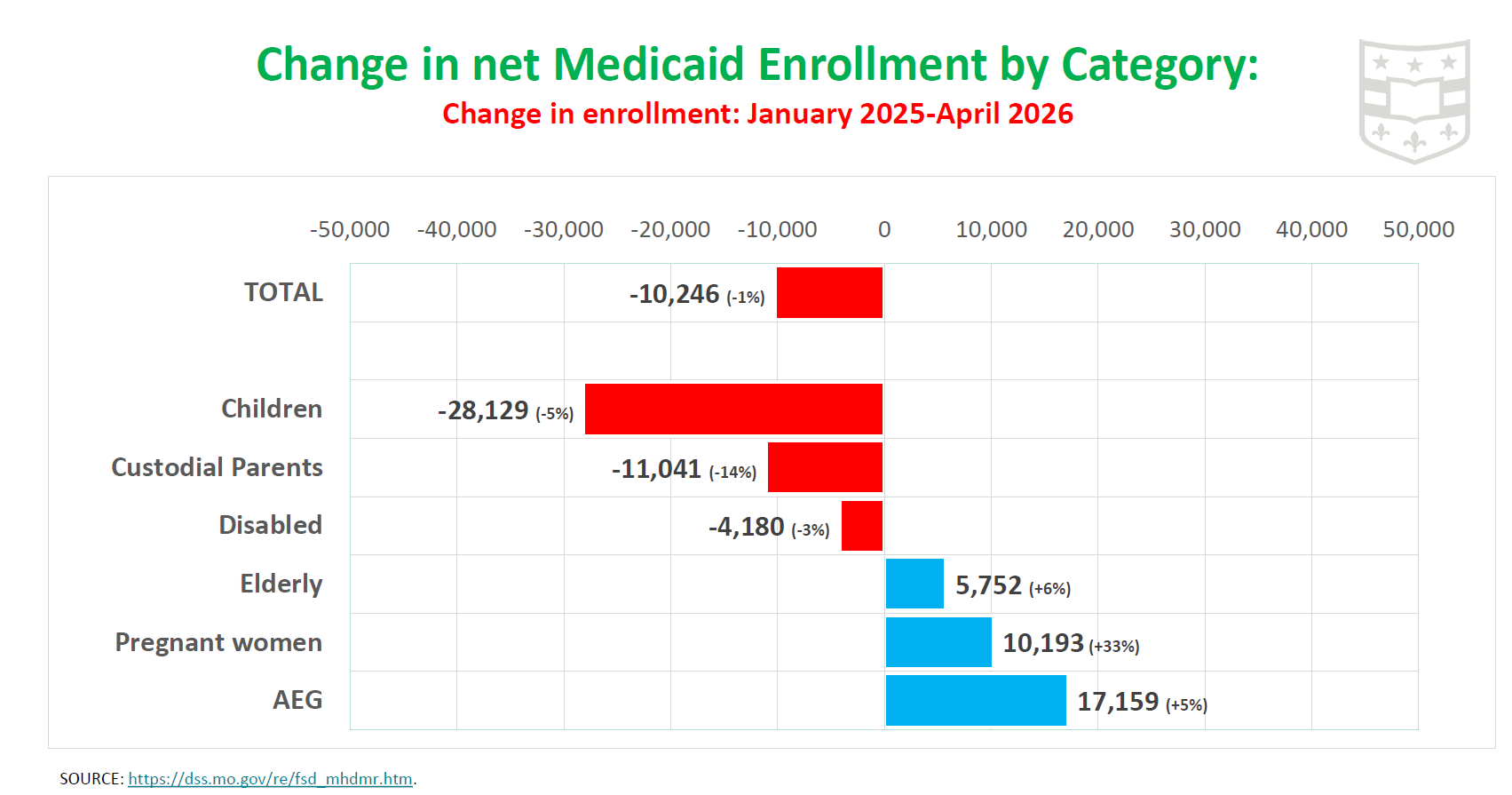
Missouri is losing children enrolled on Medicaid: over 28,000 in last 16 months (5%). This is apparently a national trend, now being described as the "chilling effect" by some.

April 2026 — Recent reports on enrollment on Medicaid in Missouri show that the number of children enrolled has dropped over 28,000 (down 5%) (see Figure below) despite virtually no change in overall enrollment and no change in eligibility criterion. Children are eligible for Medicaid in Missouri if their family income is up to 300% of the federal poverty line (roughly $82,000 for a family of three in 2026) and that eligibility criterion has not changed in recent years and was not affected by the recent legislation passed by Congress (H.R.1).
It is not entirely clear why the enrollment of children is dropping, but one possibility is that difficulties with the system of annual reverifcations is creating problems leading children to be dropped despite still being eligible for coverage. These trends raise concerns going into the implementation of H.R.1, which has mostly not begin yet (most provisions start after December 2026), since if procedural challenges already are emerging then what may happen after December 2026 could be more concerning, especially for vulnerbale populations such as children and others of need.
Recent reports point to what is described as a “chilling effect,” that is, children may lose coverage even though they are not ineligible because it is of course their parents or caregivers who handle their enrollment in Medicaid, and if they run into challenges with Medicaid systems (and may lose coverage themselves) the children in the family may lose coverage, even though they are still eligible in many if not most cases. Recent work suggests that the trend in Missouri is happening nationally, as well: Georgetown’s Center for Children and Families has pointed to a drop nationally of 1.8 million (and perhaps as high as 2 million) between January 2025 and January 2026. A recent podcast from KFF also pointed to “the chilling effects of the Trump administration’s immigration crackdown and broader confusion about eligibility requirements.”
As noted above it is not entirely clear why the enrollment of children is dropping, though a new brief from CAHSPER explores this issue further. It is worth noting that the Director of Missouri’s Department of Social Services Jessica Bax, reported in public testimony in January 2026 that “the state does not have enough staff to process the annual renewals it must complete, and her agency needs to hire additional contractors to tackle a backlog of 90,000 Medicaid renewals”. Concerns over time have also pointed to antiquated computer systems that have not been upgraded rapidly enough, and underpaid staff. Bax reported that because of these issues the state faces an “error rate” which could lead to a “clawback” of funds from the federal government. Bax reported that the department is requesting funds to “avoid putting the state in bankruptcy territory.” Bax also reported that most of the state’s Medicaid error rate “is associated with being behind on annual redeterminations for Medicaid [due to] not having enough staff.”
Children are eligible for Medicaid in Missouri if their family income is up to 300% of the federal poverty line (roughly $82,000 for a family of three in 2026). These eligibility criteria have not changed recently, nor has the percentage of families below these income levels (based on annual census data). Yet, the number of children enrolled on Medicaid has dropped from 592,002 in January 2025 to roughly 564,000 in April 2026. Moreover, the number of children on the program has dropped from 742,803 in March 2023, before the unwinding of public health emergency (PHE), dropped by over 178,000 children covered by Medicaid to roughly 564,000 (-24%).
Over the years, recipients of Medicaid have experienced problems working with the systems, including the enrollment system, and also the process of annual renewals (required by law). That latter process requires recipients (or their caregivers) to proactively respond to a written request to verify the recipient is still eligible for the program. Some recipients may submit the paperwork, but if it is not processed in a timely way, or if the paperwork is lost, or other procedural problems occur, then the recipient may lose their eligibility for the program. Difficulties with dealing with this annual verifications process are also linked to understaffing at DSS, and antiquated computer systems. Without complete information is difficult to tell if these are the reasons why children are losing coverage in Missouri, but it is likely these problems are a major source of the problem.
____
Report prepared by analysts from the Bursky School of Public Health, Washington University in St. Louis, and Center for Advancing Health Services Policy and Economics Research (CAHSPER) at WashU. Views of the authors alone.